
Overview
Courtrooms are one of the toughest rooms in AV. Every participant must be seen clearly. Every word must be captured for the record. The system has to be simple enough for a judge to drive without calling for help.
S&L Integrated Systems, an AV integrator based in Thomasville, Georgia, built a standardised hybrid courtroom package around Marshall cameras. The design uses a four-camera quad view covering the judge, witness, prosecution and defence, plus a fifth camera dedicated to live streaming. It has been rolled out to more than 100 courtrooms across multiple jurisdictions, with another 50 installations scheduled. Audio Visual Distributors (AVD) is the authorised distributor for Marshall in Australia and New Zealand, giving local integrators access to the same cameras for court, council chamber, and hearing room projects.
The Challenge: Keeping Justice Moving in a Hybrid World
The pandemic forced courts to run hearings with people in different places. That created real consequences for real people.
“The onset of the pandemic disrupted court proceedings, leading to delays, extended incarcerations and financial implications for several counties and personnel involved with the legal process,” says Stan Mobley, Senior Account Executive at S&L Integrated Systems.
Solving it meant meeting a set of demands that a standard meeting room system cannot handle.
- Every party needs a dedicated, front-facing view. A single wide shot of the room is not enough. The judge, the witness, the prosecution and the defence each need their own camera angle so remote participants can read faces and follow proceedings properly.
- Judges need to operate it themselves. Court staff are not AV technicians. The system had to be controlled from the bench during a live hearing, without training in camera operation and without an operator in the room.
- Public access had to be preserved. Open justice requires the public to observe proceedings. The system needed a live streaming feed that the judge could start and stop, separate from the videoconference itself.
- Cameras had to be discreet. Courtrooms are formal, heritage-sensitive rooms. Large cameras on tripods change the feel of the space and distract participants during sensitive testimony.
- One design had to repeat across many rooms. Rolling out to more than 100 courtrooms in different counties meant every room needed the same layout, the same controls, and the same result. A bespoke design per room would not scale.
The Solution: A Repeatable Five-Camera Courtroom Package
S&L Integrated Systems designed one videoconferencing package and repeated it. Each courtroom uses a mix of fixed-lens POV cameras and compact PTZ cameras, chosen to suit each position in the room.
Products Deployed
| Role in the Room | Product | Function |
|---|---|---|
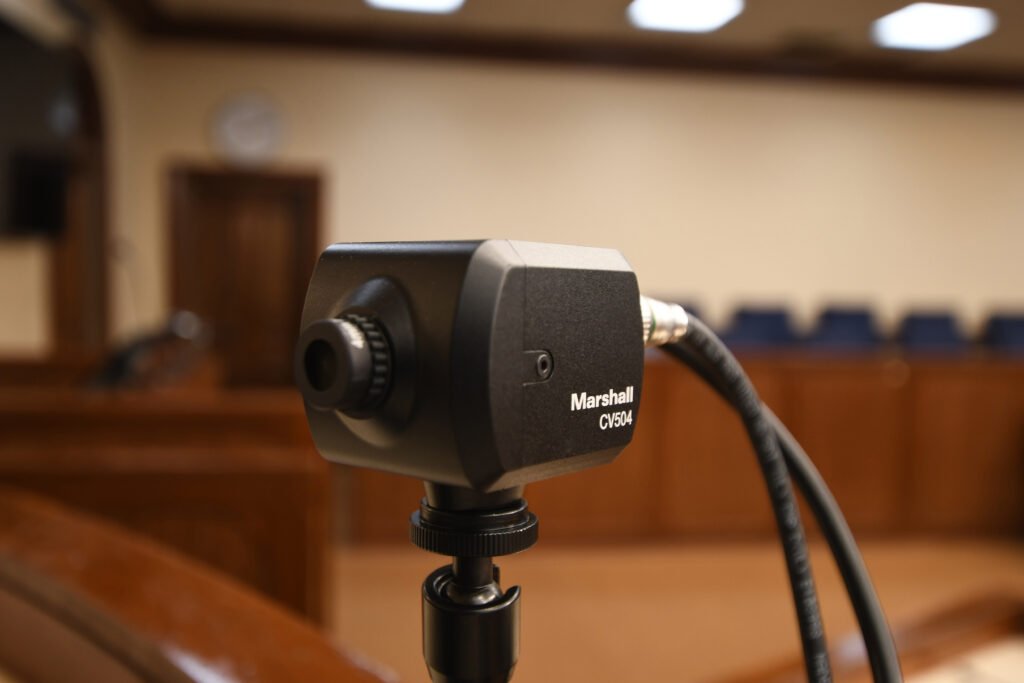
| Fixed positions | Marshall CV503 and/or CV504 Micro POV (2 per courtroom) | Small fixed-lens cameras that cover set positions discreetly. The CV504 is built around a Sony sensor with over two million pixels and delivers 10-bit 4:2:2 video performance. |
| Adjustable positions | Marshall CV-355-10X Compact 10x (2 per courtroom) | Compact zoom cameras covering the remaining quad-view positions. Features a 10x optical (12x digital) zoom block and simultaneous 3GSDI and HDMI outputs, with clear HD images up to 1920×1080 at 60fps. |
| Live streaming | Marshall CV-355-10X (fifth camera) | A dedicated camera for judge-controlled live streaming, kept separate from the four quad-view feeds so public access does not interfere with the hearing. |
How It Works
Four cameras feed a quad view. Two CV503 or CV504 fixed-lens cameras and two CV-355-10X cameras are placed to capture dedicated views of the judge, witness, prosecution and defence. The quad view arrangement means remote participants always have a front-facing feed of whoever is speaking.
The judge can trigger individual cameras. Rather than leaving the system on a fixed layout, court personnel can call up a single camera when it matters. “The ability to trigger individual cameras, such as focusing on the judge or witness greatly enhances the system’s flexibility and user-friendliness,” says Mobley.
A fifth camera handles public streaming. The additional CV-355-10X is dedicated to live streaming. The judge controls it from the bench, so proceedings can be opened to the public without a separate operator or a second system.
Compact cameras keep the room formal. The CV503 and CV504 are micro POV cameras. They mount discreetly at fixed positions and stay out of the way during sensitive testimony. The CV-355-10X offers remote adjustment of iris, white balance, exposure and pedestal, so image quality can be matched across every camera in the room without touching the units.
Key Outcomes and Results
- More than 100 courtrooms standardised. The same package has been installed across multiple jurisdictions, with a further 50 installations scheduled. One proven design now repeats from county to county.
- Hearings continue without physical attendance. Courts can run proceedings with remote participants, reducing the delays and extended incarcerations that followed the loss of in-person hearings.
- Judges operate the system from the bench. Camera selection is simple enough to use during a live hearing. No AV operator is needed in the room.
- Public access is built in. The dedicated streaming camera keeps proceedings open to the public, supporting transparency requirements without extra hardware.
- Support is part of the package. “The implementation includes comprehensive training sessions for court personnel and a client care service agreement, ensuring ongoing support and maintenance from S&L Integrated Systems,” says Mobley.
“The Marshall cameras have successfully standardized courtroom solutions across multiple jurisdictions in the area, providing a seamless and user-friendly experience,” says Mobley.
He also points to where courtrooms have landed since. “The courtroom has evolved into a hybrid environment, with an emphasis on convenience for judges to continue utilizing videoconferencing and live streaming even when physical attendance is possible,” he says. Hybrid hearings are no longer a stopgap. They are how courts now run.
Why Marshall Cameras for Courtrooms and Government AV
- Small cameras suit formal rooms. Micro POV models like the CV503 and CV504 mount discreetly at fixed positions. They cover a seat properly without dominating the room or distracting participants.
- Mix fixed and zoom cameras in one system. Fixed-lens POV cameras handle set positions. Compact PTZ cameras cover positions that need reach. Both come from the same range, so colour and control stay consistent.
- Standard broadcast outputs simplify integration. 3GSDI and HDMI outputs connect to common switchers, encoders and codecs. That keeps the design flexible for integrators building around existing court recording systems.
- Remote image adjustment saves site visits. Iris, white balance, exposure and pedestal can be tuned remotely. Cameras mounted high or in awkward positions do not need to be reached to be matched.
- One design scales across many rooms. A repeatable camera package makes multi-room and multi-site rollouts predictable to quote, install and support.
Partner With AVD
Audio Visual Distributors (AVD) is the authorised distributor for Marshall across Australia and New Zealand. Whether you are designing AV for courtrooms, council chambers, tribunals, hearing rooms, or any space where every participant needs to be seen clearly, AVD provides local stock, technical support and project consultation.
Contact the AVD team to discuss Marshall camera solutions for your next government or justice sector AV project.